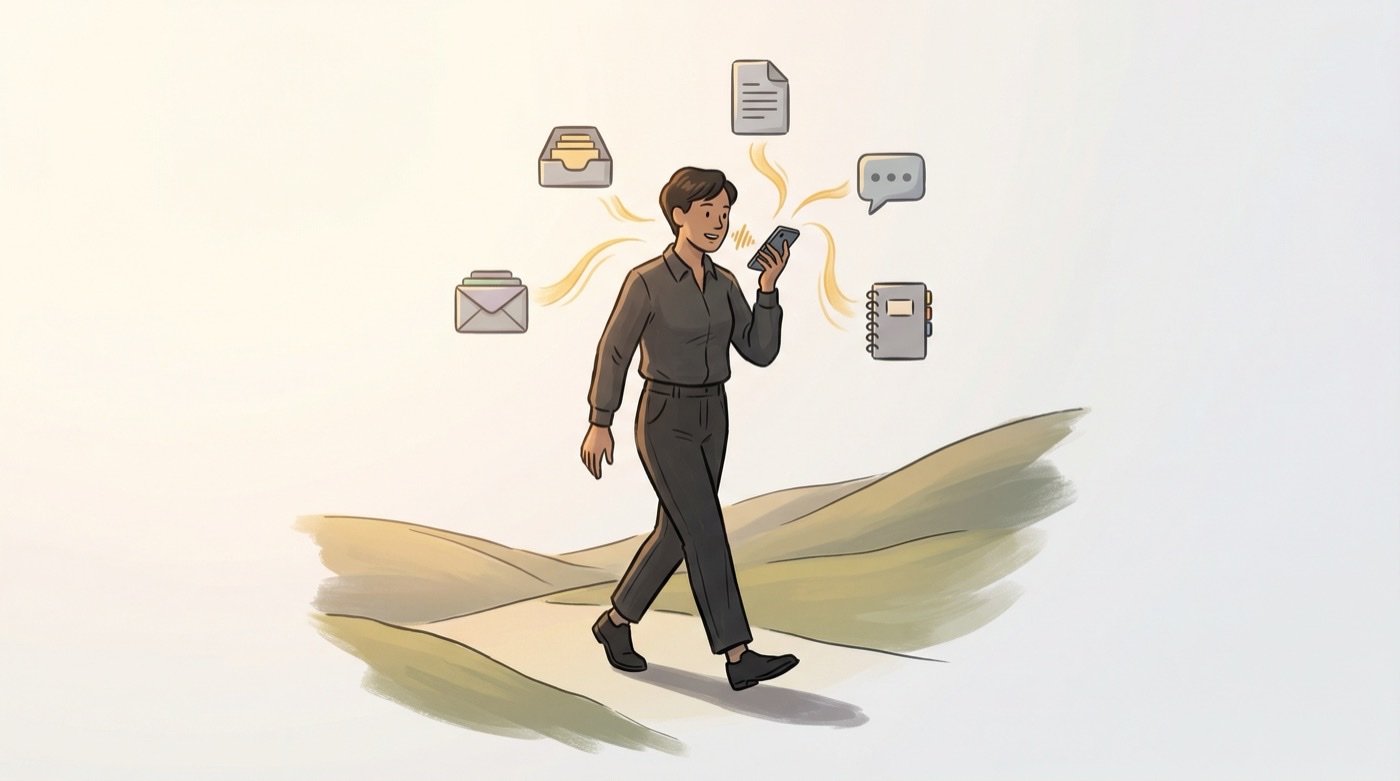
I recorded the idea for this article on a hillside above Valencia at 9am, getting some fresh air before the heat set in. Thirty seconds in WhisperMemo, the thought was captured. By the time I got back to my desk forty minutes later, it was sitting in my Obsidian inbox, transcribed and waiting. I processed it that afternoon. I’m writing it now, three days later.
At no point did the idea need to interrupt anyone. I didn’t need to write anything down to stop the thought escaping. No meeting was scheduled to discuss it. No Slack message pinged somebody out of their deep work. The thought moved from my head to my system to this article at whatever pace made sense at each stage.
That, in a nutshell, is what good async capture and communication looks like.
Capture at the speed of thought, process at the speed of attention
Most communication tools are built around synchronous assumptions. Slack expects you to respond promptly. Meetings demand your presence at a specific time. Even email – supposedly async – has developed social norms around response times that make it feel synchronous in practice, especially within organisations. Your boss is waiting for a reply… so whatever deep work you were doing, you’d better pause and answer them.
The problem is that thoughts don’t arrive on schedule. Your best idea might come while you’re hiking, or in the shower, or at 11pm when you should be sleeping. If the only way to act on that thought is to sit down at a computer and type it into a structured system, you’ll lose most of your best thinking to the gap between having the idea and being able to record it.
Voice notes close that gap. The cost of capturing a thought is thirty seconds and zero context-switching. You don’t need to open an app, navigate to the right project, or format anything. You speak. The thought is saved. You move on.
The processing happens later, when you’re actually in a position to think clearly about what to do with it. Maybe that’s an hour later. Maybe it’s the next morning. The point is that capture and processing are decoupled – and that decoupling is where the power lives.
One-way handoffs beat real-time interruptions
Here’s a principle I’ve learned from years of remote work across multiple time zones: the best handoff is one where the sender and receiver never need to be present at the same time.
When I record a voice note, I’m not sending a message that expects a reply. I’m making a deposit into a system. That system – currently Obsidian plus Claude – processes the deposit when it’s ready. There’s no back-and-forth. No “can you clarify what you meant?” ping at an inconvenient moment. The processing happens with full context, because the system already knows what I’m working on and what I probably mean.
This pattern scales beautifully. I might capture seven thoughts during a morning walk. Those thoughts are interrupting the serenity of my stroll, because they’re tugging on my attention - of course they are all brilliant transformative business ideas that will reshape the world, or they might be… I don’t want to lose them, but I also don’t want to start working on them in that moment.
So with this workflow I don’t have to, I just have to blurt out and record enough information to remind me what I was thinking about when I had the thought. They all land in the inbox. They all get processed in a single five-minute batch during my morning routine. Is this something to add to the content pipeline, is it a passing thought worthy of a social media post and no more, is it a whole new book series or business idea? That is the slow, thoughtful processing phase, that requires sitting down, and drinking coffee, to work through properly.
Now imagine I was working with a team, or even a single collaborator. Compare that flow to seven separate Slack messages, each generating a notification, each potentially derailing someone’s focus.
The cost of a voice note is thirty seconds. The cost of a meeting to discuss the same content is an hour, plus scheduling overhead, plus the attention debt of everyone involved. That equation isn’t even close.
AI as the async processing layer
Here’s where things get interesting: AI is the perfect async participant. It doesn’t mind waiting. It doesn’t have “office hours.” It doesn’t get annoyed if you dump twelve unstructured thoughts into its inbox at 6am and don’t come back until noon.
It doesn’t do any processing of its own; it has no view on whether that is a rubbish idea from the depths of mild oxygen starvation, having stumbled up a ridge on a hill. It just quietly captures the content. If it’s the middle of the night when the thought happens, then I can get back to sleep with that little bit more calm and space, my subconscious no longer fighting to hang on to that spontaneous brilliance for the morning.
Claude processes my inbox without any need for synchronous interaction. It reads a voice transcript, understands the context, identifies whether it’s a task, a reference note, or a project idea, and routes it accordingly. If it needs a decision from me, it flags it. If it can file it directly, it does. My morning review process takes care of it, one item at a time, when I am ready, and the coffee is brewed. The entire interaction is asynchronous – I deposit, it processes, I review.
This is fundamentally different from how most people use AI. The default interaction model is conversational: you type a prompt, wait for a response, type another prompt. That’s synchronous. It requires you to be present and engaged for the entire exchange.
The inbox pattern is async by design. I capture throughout the day. Processing happens in a batch. Decisions get made when I’m in decision-making mode, not when the thought first occurred. This respects both the natural rhythm of creative thinking and the practical reality of a working day that includes school runs, gym visits, client calls, spanish lessons, and making dinner.
Jim’s philosophy: the deliberate inbox
Jim built the technical side of our systems, and he has a principle that sounds counterintuitive until you think about it: never give AI direct access to live systems.
He’s seen the horror stories. An AI agent with write access to a production database that “helpfully” reorganised the schema. An automated tool that sent emails on someone’s behalf without confirmation. The OpenAI agent demos where an AI books flights and makes purchases – exciting in a pitch deck, terrifying in practice.
His approach is the deliberate inbox. AI can read from live systems, but it writes to an inbox that a human reviews before anything happens. Want to create a task? It goes to a staging area first. Want to file a note? It proposes the location and you confirm. Want to send an email? It drafts and you review.
This is async communication applied to the human-AI relationship itself. The AI captures its proposed actions asynchronously. The human reviews and approves them at a time that makes sense. Nobody – human or AI – is taking consequential actions in real time without a review step.
The result is a system you can actually trust, because “trust” in async systems means knowing that nothing irreversible happens without deliberate confirmation.
What this means for remote teams
If you’re a solopreneur, async communication with AI is already transformative. But the principles apply even more powerfully to teams.
The remote teams that struggle are almost always the ones that transplanted office communication patterns to distributed work. They replaced hallway conversations with Slack messages and in-person meetings with Zoom calls. The medium changed; the synchronous assumption didn’t.
The remote teams that thrive are the ones that redesigned their communication for async by default. They write things down instead of saying them in meetings. They use structured handoffs instead of real-time chat. They batch decisions instead of making them one interruption at a time.
Adding AI to this pattern amplifies it further. Meeting notes get summarised and action items extracted automatically. Documentation gets updated without someone having to remember to do it. Context that used to live in one person’s head gets captured and made searchable for the whole team.
The deeper point
Good communication has never been about speed. Human and AI brains relate to speed in completely different ways anyway. Far more important are clarity, context, and respect for other people’s attention. Real-time communication optimises for speed at the expense of everything else. Async communication optimises for quality of thinking and respect for everyone’s time – including your own.
I do some of my best thinking on hillside walks where there’s no mobile signal. The system I’ve built means those thoughts don’t get lost. They get captured, processed, and acted on – all without a single meeting, a single notification, or a single interruption to anyone’s deep work.
That’s what a superpower actually looks like. Not doing more, faster. Doing better, at the right time.