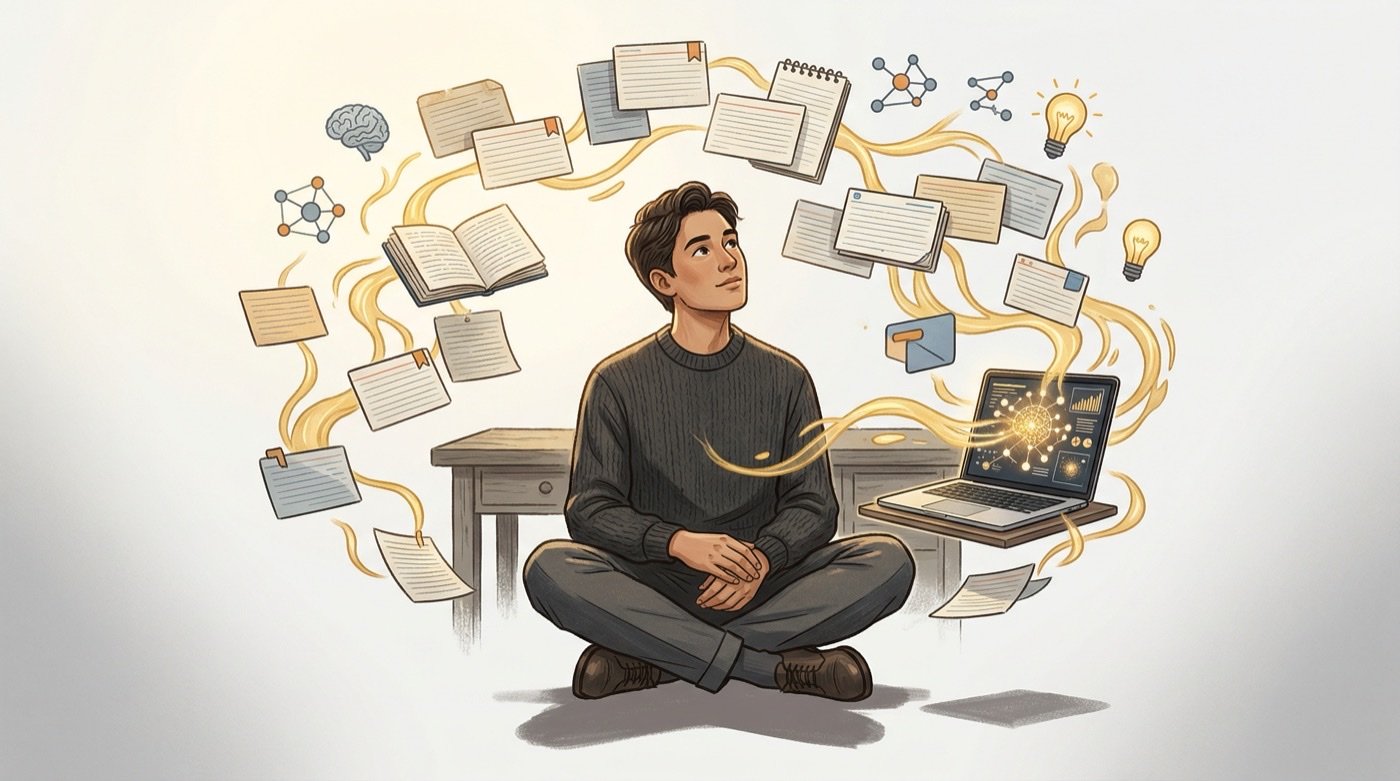
My mother used to be a librarian before I was born, and was often horrified at the way I treated my books. Folded corners, margin notes, highlighters… Especially non-fiction, I’d do anything to try and make connections with ideas I was having, things I already knew, and stuff that was - going to be important somehow, one day, maybe, probably.
Notebooks, journals, planners, stickers, and Post-it notes. I bought the books on how to make good notes back in my student days, while my personal reality was always a lot messier, and harder to find the connections within and between. So when the digital tools came along, I knew I’d been born for this moment, I was ready. And so I started capturing and connecting in just about every way I could get my hands on. I’ve used Evernote, Notion, Google Keep, Apple Notes, Trello, random text files in Dropbox, and at least three apps I can’t even remember the names of anymore. Each one promised to be the system that would finally make me organised.
None of them did – not because they were bad tools, but because capturing information was never actually the hard part.
The yellowing paperbacks with the faded marginalia that I packed up in boxes and moved from one country to another may have held my earliest thoughts, but they had no connection to what I am thinking or learning today, or next week, however diligently I had captured them. My first published book (on managing research fieldwork, 2016) began life on piles of index cards, spread and shuffled on the dining room table, as I tried to map the connections and through lines to make sense of the structure and storyline. Of course I wrote it on my laptop, but the ideas and planning I could find no way to organise digitally.
I was full of ideas, but the challenge was always knowing what on earth to do with it afterwards.
The Zettelkasten: where it started
I was not alone in this struggle, and over the years many way more intellectual pre-digital types had striven to find a way of joining these dots and supporting our organic brains with some kind of backup library of resources with connections between them.
The original second brain belonged to a German sociologist called Niklas Luhmann. Between the 1960s and his death in 1998, he produced over 70 books and 400 scholarly articles – an almost absurd output. His secret was the Zettelkasten: a physical cabinet of around 90,000 index cards, each containing a single idea, cross-referenced to other cards through a numbering system.
The genius wasn’t in the cards themselves. It was in the connections between them. Luhmann described his Zettelkasten as a “communication partner” – a system that could surprise him by surfacing unexpected links between ideas he’d captured months or years apart. He wasn’t just storing information. He was building a web of thought that grew more valuable with every addition.
But what nobody mentions when they evangelise the Zettelkasten method: Luhmann was a full-time academic with decades of practice. The system worked because he had the discipline and the time to maintain it meticulously. Most of us don’t.
The digital capture era
When Evernote launched in 2008, it felt revolutionary. Suddenly you could clip web pages, photograph whiteboards, scan receipts, and throw it all into a searchable database. “Remember everything” was the tagline, and for a while it felt like that might actually be possible.
The problem was that remembering everything and being able to find what you need are two completely different capabilities. I had thousands of notes in Evernote. Finding the right one at the right moment? That required me to have already tagged it correctly, or to remember enough keywords to search for it.
The tool captured beautifully but it didn’t think. It was a filing cabinet, not a brain. It was a filing cabinet that filled up fast and was slow to sync as well, especially with the storage limits and data speeds of the early 2010s. But it was a big step forward, and I sensed the power it held.
Notion took it further – databases, linked records, templates, relational views. You could build genuinely sophisticated systems. People did. Some people spent so much time building their Notion systems that they forgot to actually do the work the systems were meant to support. The tool became the project.
And yes, I learned this the hard way. Perfecting the ultimate dashboard, designing the most complex primitives, and trying to ride herd on a raft of fragile integrations, was a full time job in itself, as well as the greatest way to procrastinate instead of actually being productive.
The movement was growing, though, and the vocabulary was evolving. Productivity bloggers (the ultimate procrastinators?) started talking about PKM, Personal Knowledge Management. ways of bringing together what you learned, what you thought, what you studied, and what you were going to do with it all later. Approaches and models started to differentiate.
PARA and the organisation breakthrough
Tiago Forte deserves genuine credit for what he did with the PARA method and Building a Second Brain, first published in 2022. He gave people a framework – Projects, Areas, Resources, Archives – that finally answered the question “where does this go?” in a way that made intuitive sense. His insight was that organisation should follow actionability: things you’re working on now go in Projects, ongoing responsibilities go in Areas, reference material goes in Resources, and everything else goes in Archives.
It was the first time I’d seen a system that respected how knowledge actually flows through a working life. Forte made PKM accessible to people who weren’t academics or productivity nerds, which really mattered.
But PARA still had execution gaps. The method required regular review of notes, condensing and highlighting and reminding yourself of what was in them, and taking the time to really think about their relevance and usefulness. The Resources and Archives buckets were essentially cold storage. You put things there, and hoped you’d remember to look for them when you needed them. The system depended on your future self knowing what your past self had saved and where, and being able to figure out how stuff might relate to other stuff. It was better than what came before, certainly. It still required you to be the search engine for your own knowledge.
The context revolution
Here’s what’s changed, and it’s happened remarkably fast. We’ve gone from “how do I organise my information?” to “how do I manage my personal context?” – and these are fundamentally different questions.
Information is out there. Anything factual, anything that’s been published, anything that exists in a training dataset – you can look it up or ask an AI about it. The stuff that Google knows, Claude knows, ChatGPT knows. That means you can know it, so stuff is not a scarce resource anymore.
What’s scarce – what’s genuinely irreplaceable – is your context. The things that aren’t in any training data and never will be. Your specific experiences. The relationship you have with that difficult client. The insight you had on a Tuesday walk, about why your pricing model isn’t working now. Your opinion on a topic based on fifteen years of working in your field. The connection between that podcast episode you half-listened last night and the proposal you need to write next week.
A truly personal second brain isn’t a knowledge base. It’s a context base. And that reframing changes everything about how you build one.
What a context-first system actually looks like
My current system runs on Obsidian and Claude, and it’s the first time I’ve felt like I have an actual second brain rather than a glorified filing cabinet. Here’s why.
Obsidian stores everything as plain Markdown files on my hard drive. No proprietary format, no cloud dependency, no subscription that could disappear. The files are mine. They’re human-readable. They’ll work in twenty years.
But the transformative piece is what happens with AI in the loop. I capture thoughts via WhisperMemo while I’m walking – thirty seconds of voice, transcribed and dropped into my inbox. Not polished writing; raw thinking. The kind of fleeting thought that used to vanish before I got back to my desk.
Then Claude processes that inbox. Not by filing things into neat categories, but by understanding the context. It knows what projects I’m working on. It knows my weekly review is on Friday. It knows that when I mention “the Spain ID cards article” I mean a specific draft in a specific folder. It can connect a voice note from Tuesday’s walk to a task that’s been sitting in my project list for three weeks.
This is what Luhmann’s Zettelkasten was trying to be: a system that surfaces connections you didn’t consciously make. Except instead of requiring decades of meticulous index card maintenance, it runs on voice notes captured between the school run and the first coffee of the day. Retrieval, at the exact moment it is needed, does not require my Mum to file it away on a shelf according to the Dewey decimal system, it’s all there for instant accessibility.
The gap between capture and action
The older I get, the more I think the entire history of personal knowledge management has been solving the wrong problem. We got really good at capture. We got reasonably good at organisation. But the gap was always between having the information and doing something useful with it.
That gap is where context lives. It’s the understanding of why this note matters now, what it connects to, and what action it implies. A human can do that, but only for a handful of things at once, and only when they remember to look. An AI with access to your full context can do it across everything, all the time.
I’m not saying AI replaces your thinking. It doesn’t. The opinions, the judgements, the creative leaps, those are still yours. What AI replaces is the tedious, error-prone work of maintaining connections between your thoughts. The stuff that made Luhmann’s system brilliant but impractical for most humans.
Your second brain should be uniquely yours
This is the part that excites me most. A second brain built on your personal context is genuinely unique. Nobody else has your combination of experiences, relationships, opinions, and ongoing projects. Nobody else’s AI assistant has been trained on your specific workflow and your particular way of thinking through problems.
That’s not a limitation – it’s the entire point. The value of a second brain was never in storing publicly available information. It was always in the connections between your private knowledge and your current needs. We finally have tools that can work at that level.
If you’re still trying to build a second brain by perfecting your tagging system or designing the ideal Notion template, I’d gently suggest you’re solving yesterday’s problem. The question isn’t “where does this go?” anymore. The question is “what does this mean, in my context, right now?”
And for the first time, we have tools that can help answer that.
This is part of our series on building AI-powered workflows for solopreneurs. See also: Getting Things Done in 2026 for how GTD methodology finally works when AI handles the processing.