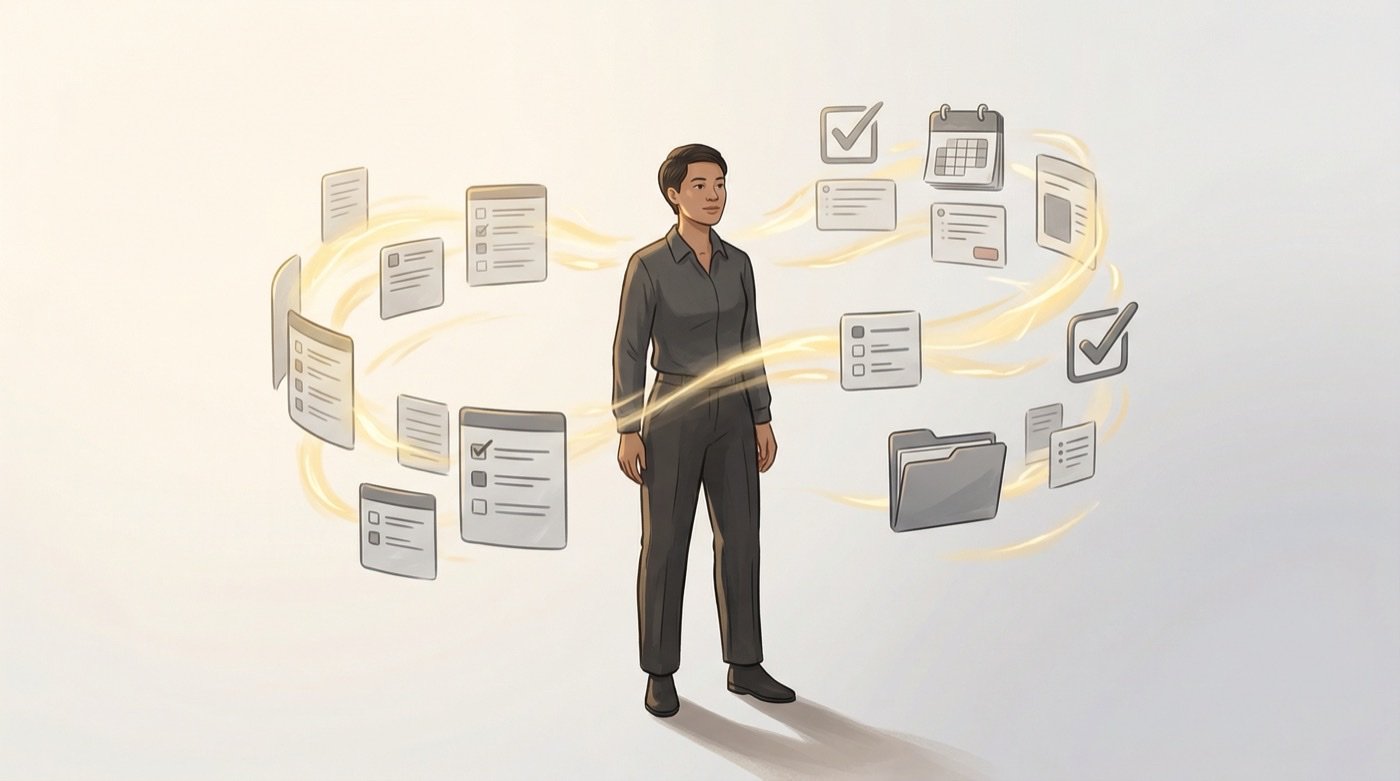
I first read David Allen’s Getting Things Done soon after its publication in the early days of the new century. At that time I was a young mum, trying to build a business and manage working from home and living at work, back in the days that meant unplugging the phone to turn on the internet. I was drowning in open loops, in stuff, in disconnected buckets of responsibilities in my life, that nevertheless took place in overlapping situations.
The methodology made immediate, intuitive sense – capture everything, clarify what it means, organise it, schedule it, reflect regularly, engage with confidence. Figure it out from the ground up, starting with what’s got your attention and things you have to do, working up through how those groups are projects, responsibilities, and higher-level goals and strategies.
It made sense in a way no previous productivity books had done, the ones which wanted you to figure out your life purpose first, before you could possibly drill down to your immediate responsibilities. Simple, elegant, powerful. I was sold. I bought copies of the book for all of my team members and other people. I joined the forums and nerded out, got my paperback signed when Mr. Allen came on a speaking tour to the UK. I even bought a Dymo labelling machine (believe me, IYKYK.)
For the next two decades, I attempted GTD with paper notebooks, elaborate printed planners, project folders, and yet more sticky labels.
Then came Todoist, OmniFocus, Things, Trello, Notion, and combinations thereof. Post-it notes of every size and colour imaginable. The method definitely helped me through some very complex moments in my life, including moving my whole family to another country, writing books while working full-time, and transitioning to freelancing without a safety net.
But it always felt like a discipline, a practice I never perfected. Each return and recommitment to the method lasted somewhere between two weeks and three months, before something in the system collapsed under its own weight: The weekly review stopped happening. The inbox overflowed. My family would not put stuff in the shared calendar. Projects drifted without next actions, and I started making lists of lists on scraps of paper so I didn’t miss anything.
When it got really out of hand I’d declare GTD bankruptcy, archive everything, and start again. And often there was a shiny new app to do it all over with. This time, it’s going to be different!
Sound familiar? I don’t think I was the problem. The tools were.
Where GTD always broke down for me
Allen’s framework has five stages: Capture, Clarify, Organise, Reflect, Engage. The first one – Capture – was always the easiest. People love capturing. Every productivity app ever built is great at letting you throw things into a bucket.
Clarify is where things get difficult. For every item you capture, you need to ask: What is this? Is it actionable? What’s the next action? Does it belong to a project? Can it be done in two minutes? Should it be delegated? Deferred?
For a solopreneur processing fifty or sixty captured items a week, that’s a significant cognitive load – and it needs to happen regularly, or the whole system silts up.
David Allen talked about a “mind like water,” where you had absolute focus on that item you were processing as it passed in front of you, because you knew every other call on your attention was correctly filed and calendarised in a perfect system where it would unfailingly be surfaced at the optimal moment. But whenever I was trying to process my inboxes, I always seemed to have part of my brain elsewhere, wondering about something I had to do, which may have been forgotten, that clearly wasn’t adequately dealt with or stored as it should be.
Organise follows naturally from Clarify, but it requires a structure that actually works for your life. Allen’s original contexts (@phone, @computer, @errands) made sense in 2001, when you weren’t always at a computer, and if you were, it may or may not have been online.
They make less sense when your entire working life happens on a laptop and smartphone. PARA – Tiago Forte’s Projects, Areas, Resources, Archives framework – filled the organise gap beautifully for knowledge workers, giving us a structure that maps to how modern work actually flows, and replacing GTD’s carefully-labelled cardboard folders and tickler files.
But the real bottleneck was always Reflect. The weekly review. Allen calls it “the critical success factor” for GTD, and he’s right. Without regular review, your system becomes a graveyard of good intentions, more importantly it stops being a system that your brain intuitively trusts enough to let go of the rest of the time.
The problem was that a proper weekly review takes forty-five minutes to an hour, requires real mental energy, and there is no shortcut. I tried every possible way to make this a consistent process. I bought other people’s Notion systems and dashboards at great expense; then when they didn’t fit my workflow, I made my own. Stuff still fell through the cracks in my brain, and often I simply didn’t have the energy or bandwidth to do my weekly review when I scheduled it on my calendar.
So I deferred it to next week and told myself I would do it then. By which time there’d be even more stuff in the backlog.
For years, this is where my GTD practice went to die.
The store-and-reference problem
There’s a subtler issue that Allen himself acknowledged but never fully solved: what do you do with stuff that isn’t actionable but feels important?
In GTD terms, this is “reference material” – things you want to keep but can’t act on right now. A useful article. Meeting notes you might need later. An idea that’s not ready to be a project yet. Research for something you’ll write someday.
Allen’s solution was essentially “file it where you can find it.” In the early aughts this meant a huge metal filing cabinet, where you put the clippings and the brochures and the things you printed out from the internet, long before even Evernote existed to attempt to replicate this digitally.
Forte’s PARA method improved on this enormously – Resources and Archives gave reference material a proper home with clear rules about what goes where. But even with PARA, the underlying problem remained: you’re storing things in the hope that your future self will remember to look for them at the right moment. And making connections between the different ideas was still a completely manual and intentional process.
This is the gap that no productivity methodology, no matter how elegant, could fill with human effort alone. You need something that can hold more context than a human brain, review it tirelessly, and surface the right reference at the right time.
David Allen knew what he was talking about two decades ago when he said, *“Your brain is a great place for having ideas but not for storing them.”
Human brains were never built for this stuff. You need an AI.
How AI closes the execution gap
Here’s what my actual GTD system looks like in 2026, and it’s the first time I’ve felt I was genuinely doing it well:
Capture happens continually. I forward emails that need more than a moment’s processing, or where I want to ensure a follow-up or to-do happens. AI tools transcribe and summarise calls and meetings. Changes in the repos I share with Jim are tracked when one of us does a thing that triggers something for the other person.
Away from my desk, I use WhisperMemo to record voice notes at any moment – waiting for coffee, between meetings - thirty seconds or 9 minutes of raw thinking, transcribed automatically and dropped into my Obsidian inbox. If I have a thought, it gets captured. Always.
Clarify is where Claude comes in. My morning routine includes a processing step where Claude reads through the inbox and helps me clarify each item. It asks the right questions – “Is this a task or a reference note? Does this belong to an existing project? What’s the actual next action here?” – and it does so with full context of my current projects, areas, and commitments. It knows that when I mumble something incoherent about “the newsletter” at 7am on the way to a yoga class, I mean this week’s Remote Work Europe newsletter, and that it’s due Thursday.
Organise follows naturally. Tasks go to Todoist with appropriate due dates and priorities. Reference material gets filed into the right Obsidian folder. A daily and weekly note is populated with everything I have to deal with or that I’m waiting for from somebody else. Project notes get appended to the right project file.
This used to take me thirty minutes of dragging things between lists. Now it takes five, because Claude does the sorting and I just confirm.
Reflect – the weekly review that used to kill my GTD practice – now actually happens. Every Friday, a review skill walks through my projects, checks for stalled next actions, flags things that haven’t moved in two weeks, and surfaces commitments I might have forgotten. I still need to make the decisions – what to prioritise, what to defer, what to drop – but the preparation work that used to make the review feel like a chore is handled for me.
Despite working from home 95% of the time and the boundary issues this creates for many people, I then get to close my laptop and step away. I am confident that all the loops are closed, I can zap in any passing thoughts over the weekend as voicenotes, and that even if I don’t know what I’m doing on Monday morning Claude does, and will sync me up when I log back in.
The human in the loop - always.
Engage is the part that was always up to me, and it still is. No AI is going to write the article, have the client call, or make the strategic decision. That will never change.
But I engage with vastly more confidence because I trust my system. Nothing is falling through the cracks. Every commitment is tracked. Every piece of reference material is findable.
I remember the day I told Jim, “I think after 20 years I’m finally doing GTD properly.”
I finally had the system that supports the methodology, in a way that purely human-operated tools never could.
The hybrid reality: what AI can’t do
Here’s the honest part that some productivity influencers won’t tell you: even with the best AI in the world, certain things need specialised tools and human discipline.
Temporal awareness is the big one. AI is extraordinary at processing, connecting, and recalling information. It is genuinely terrible at knowing what time it is. Claude doesn’t know today’s date unless you tell it. It can’t reliably calculate “two weeks from Thursday.” It doesn’t understand that a flight departure at 3pm is non-negotiable in a way that a content deadline is not.
So the system is hybrid. Todoist handles time-bound tasks and recurring routines because that’s what it’s built for (and it is really good at that two-weeks-from-Thursday thinking.) Google Calendar holds the immovable commitments. Claude checks both of these, and handles everything that requires understanding context rather than tracking time. Each tool does what it’s best at; none tries to do everything.
Decision-making remains entirely human. Claude can tell me that three projects have stalled and suggest which one to prioritise based on deadlines and dependencies. But the actual prioritisation – weighing client relationships, personal energy levels, strategic direction – that’s mine. The system supports the decision; it doesn’t make it.
Discipline still matters, just differently. The old discipline was “maintain your system perfectly or it collapses.” The new discipline is lighter: capture your thoughts, run the morning routine, do the weekly review. The system handles everything in between. It’s the difference between maintaining a complex machine and maintaining a simple habit.
Why this matters for solopreneurs
If you’re employed by a company, you might have a manager who gives you direction and instruction, an executive assistant, a team that catches things you drop, and a project management system that tells you what to work on next. So even an imperfect personal system is buffered by the people and tools around you.
Solopreneurs have no buffer. When something falls through the cracks, there’s no one else to catch it. A missed follow-up, a forgotten commitment, a reference document you can’t find when you need it… these have direct consequences for your reputation and your revenue.
GTD was always the right methodology for solopreneurs. The promise – “a mind like water,” total clarity on commitments, nothing nagging at your subconscious – is exactly what you need when you’re running everything yourself. The problem was that maintaining the system was itself a significant overhead, and overhead is precisely what solopreneurs can’t afford.
AI doesn’t change the methodology. David Allen got it right in 2001, and the core principles haven’t needed updating.
What AI changes is the cost of implementation. The weekly review that took an hour now takes twenty minutes. The inbox processing that required thirty minutes of focused thinking now takes five minutes of confirmation. The reference filing that you used to skip entirely now happens automatically.
For the first time, the overhead of running GTD properly is low enough that a real person, with a real business and a real life, can actually sustain it. That’s not a small thing. That’s the thing the productivity world has been chasing for twenty-five years.
This article is part of our series on AI-powered solopreneur workflows. For the knowledge management foundation that makes this work, see The Evolution of Second Brains.