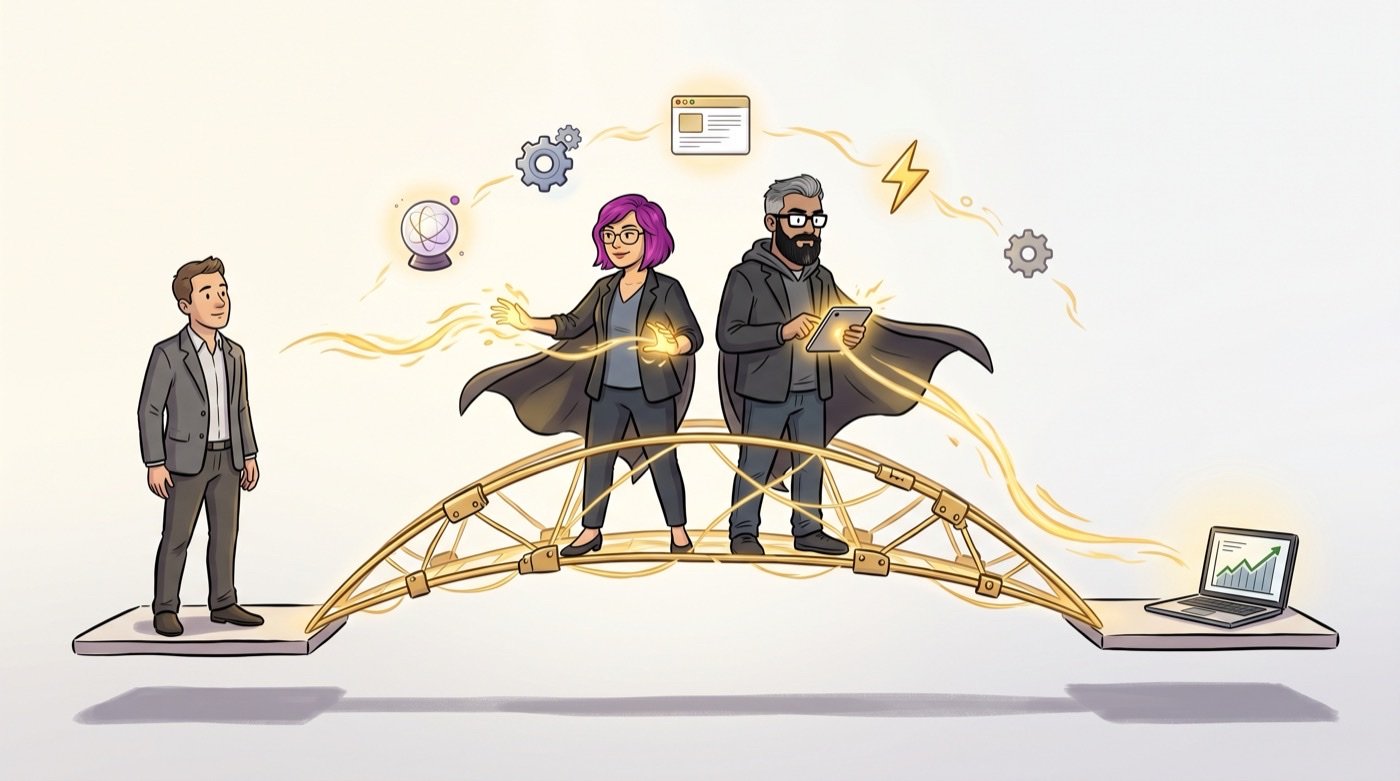
Yesterday Anthropic started their developer conference, Code with Claude, in San Francisco. They didn’t unveil a new model. The whole event was about closing the gap between what their models can already do and what people actually do with them.
That’s an unusual posture for a developer conference. The default move is a capability launch — a new model, a fresh benchmark score or a headline demo. Instead they spent the day on tooling, capacity, and adoption.
The Bottleneck Just Moved
Their Chief Product Officer, Ami Vora, put it plainly: “Model capabilities are improving on an exponential, most organizations are still adopting AI on a linear path. And that means there’s a gap between what AI can do and what it’s actually doing for people.”
That line frames everything else they shipped: doubled rate limits on Claude Code, cloud agents that fire on a schedule or a webhook, a mode where the agent reviews its own past sessions overnight and writes lessons to memory for tomorrow, and a production setup for shipping automated software without hiring your own operations team.
Each of those works on the substrate around the model, not on the model itself. The bottleneck has moved — from can the model do it to can the work actually get done.
Anthropic is the company most aggressive about pushing model capability into the wild. They just spent a day saying capability isn’t the constraint anymore.
We’ve Been Saying the Same Thing
That gap is the one we love working in.
Solopreneur Superpowers exists because most of the people we serve — solo operators, small teams running everything themselves — have ideas they can’t reach. They know what they want their business to do. They know what would give them a quieter Tuesday and a longer runway. What they don’t have is the bridge between the idea and the working tool.
Anthropic just acknowledged that the bridge is the hard part — not the model, not the API, but the bridge.
We’ve been saying the same thing in our own way for a while now. Frontier models, AI agents that can run for hours, building blocks for stitching together a workflow — the capability is out there. And while almost nobody we talk to is short on capability, they’re short on the time, the attention, and the cumulative know-how to translate that capability into something that runs inside their actual business.
How We’re Levelling Up
Claude Code is one of several tools we build with — alongside the rest of the AI tooling stack and a long tail of conventional infrastructure that most automated work still depends on. From yesterday’s announcements, three pieces stand out for the kind of work we do.
The doubled five-hour rate limits on Claude Code give us more headroom for the long custom workflows clients need shipped today, not when the next usage window resets. Routines are Anthropic’s name for cloud agents that fire on a schedule or a webhook. They let us hand a client a workflow that runs itself — say, when their inbox gets a particular kind of email — with nobody on our side in the loop. And Managed Agents make it more practical to ship a piece of automated software to a client and trust it’ll behave when nobody’s watching.
Each of those becomes better material for work we already do. We were going to do this work either way; now we have a few better tools for it.
The Bridge Still Has to Be Built
Better tools shrink the work. They don’t finish it.
Someone still has to look at your business, listen for what would actually keep working, and assemble the pieces in the right order. That part doesn’t get easier when the model gets better. If anything, it gets harder — every release adds new openings and new traps, more options for what you could build, more decisions about what you should. The work of choosing what to build, and then making it stick, is its own discipline.
That’s the work we do. Anthropic and a handful of others build the substrate — frontier models, hosted agent platforms, automation building blocks. We build the bridge between your business and whichever pieces of substrate fit it. Without the substrate moving, our bridges would be flimsier. Without the bridge, the substrate is a research lab open to the public, and most people aren’t going to walk in.
Yesterday’s announcements gave one part of our toolkit better materials. The bridging is still ours to do.
What Would You Create?
If you’ve been watching the AI conversation and wondering what any of it means for your business, here’s our question:
What would you create, if you had access to your own superpowers?
Maybe it’s a customer task that finally handles itself, a pipeline that runs without you opening a tab, a Tuesday morning that’s already started before you sat down.
Tell us what it is, and we’ll help figure out the rest.