Case Study

Marcus Garvey

An actor's website that keeps its own screen credits current — new roles spotted automatically, approved by Marcus, published to a site he owns.

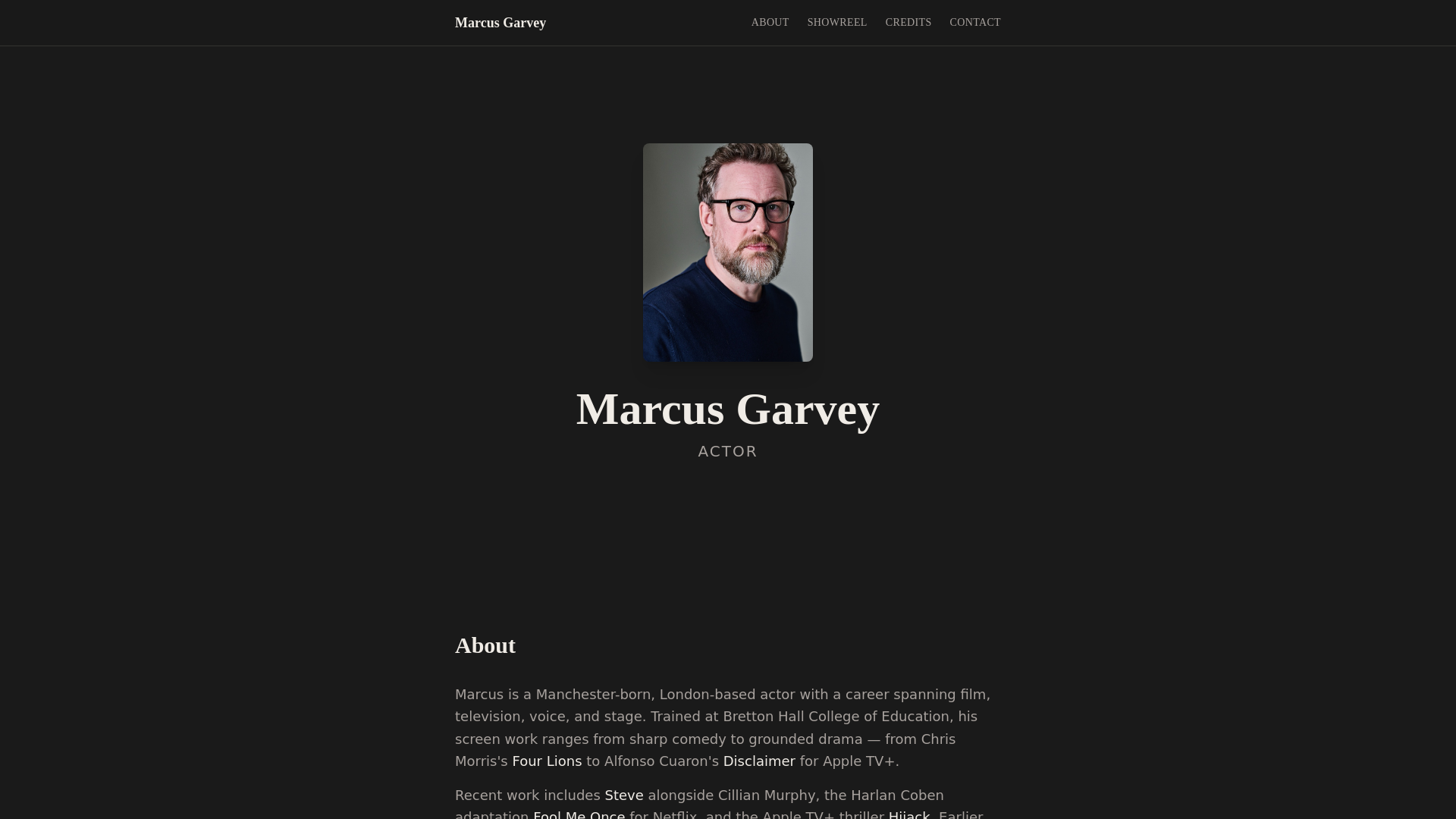
The marcusgarvey.actor homepage — an actor portfolio site with headshot and screen credits

What we built around: Marcus is a working screen actor — Four Lions, Broadchurch, Hijack, a body of work that keeps growing. His superpower is the work itself. What he shouldn't have to do is keep a website in step with it. We built a system around the career he's already having, so the site stays current as the credits land — without him having to remember to update it.

An actor's site is only as good as its credits — and credits are exactly the thing that falls out of date. A role airs, the agent's listing updates, IMDb catches up, and the personal site quietly lags months behind, showing last year's work to this year's casting directors. We fixed that at the root: marcusgarvey.actor now watches for new credits itself, checks with Marcus before anything goes live, and publishes to a site he fully owns.

Weekly His credits checked against TMDb and his agent's listing — on their own
Human-approved Nothing reaches his public profile without his say-so
He owns it On his own domain — portable, no platform to price him out
Before

The website that fell behind the career

  • A role airs, and the site still lists last year's credits
  • The agent's page and IMDb ahead of his own site, month after month
  • Nudging someone to make every small update — or letting it slide
  • A professional profile that quietly went stale between jobs
After

Now the site keeps up on its own

  • New credits surface automatically, week by week
  • A quiet heads-up when there's genuinely something to add
  • Marcus approves it in a moment — or ignores what isn't his
  • It publishes to his own site, structured so Google and casting tools read it right
  • Casting directors always see a current, accurate profile

What this looks like day-to-day

His site is never the last to know

When a new role lands, the site finds out on its own and flags it — instead of Marcus remembering to add it, or an old version lingering for months.

He stays the editor of his own story

Nothing is published automatically. Marcus sees what's new and approves what's genuinely his — the profile is shaped by him, not by whatever a database happens to hold.

Casting sees the real, current him

The credits are structured so Google and casting tools list him correctly and up to date — the version of Marcus that gets seen is the accurate one.

It goes wherever he goes

The whole thing runs on a site he owns outright — no platform behind it that can lock him in, change the rules, or price him out later.

A site that keeps its own credits current

Under the site is a quiet loop that does the chasing so Marcus doesn't have to:

  1. Credits that surface themselves

    Every week it checks TMDb and his agent's official listing for anything new — no one has to go looking.

  2. He stays the editor

    A new credit becomes a heads-up, never an automatic edit. Marcus approves what's genuinely his. (The system once turned up a 1975 documentary — about Marcus Garvey the civil-rights leader, not the actor. The approval step caught it before it could reach the site. That's the whole point of keeping a human in the loop.)

  3. Published to a site he owns

    Approved credits go live on his own domain, with the structured data that lets Google and AI tools list him correctly — and stay in sync with Wikidata.

  4. Portable forever

    A site he owns outright: fast, on his own domain, with no platform that can lock him in or price him out.

Want a case study of your own?

Every operator is different. Start with a 10-minute diagnostic — we'll come back with a personalised brief on where AI could turn the work you already do well into something that compounds.