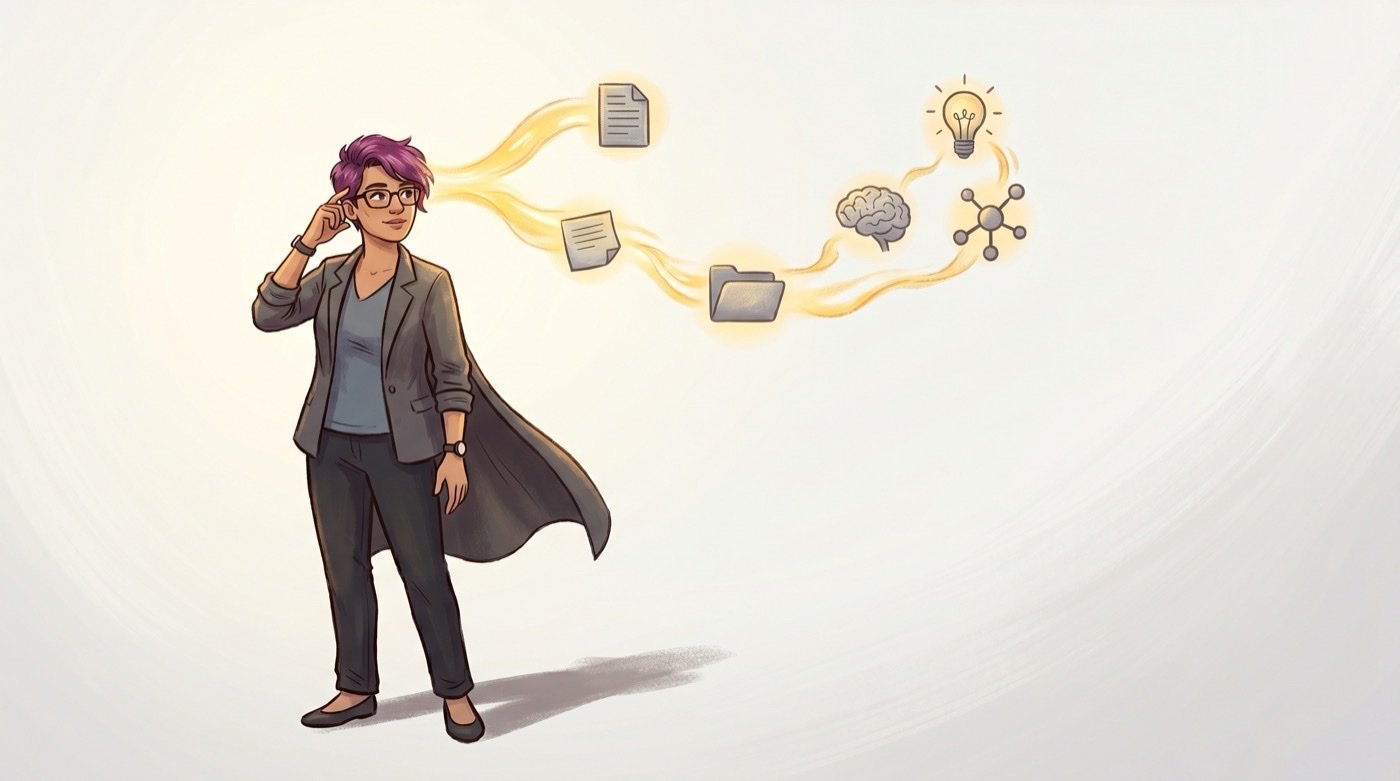
You know that feeling when you wake up at 3am remembering something you were supposed to follow up on?
Or maybe you still don’t remember the thing, but the feeling kicks in anyway when you least expect it. That nagging background hum of anxiety about things you might be forgetting. The moment of panic when a client mentions a conversation you know you had, but you can’t quite recall the details, or the sense of unfinished business about something that had a deadline and you’re not sure if it’s tracked anywhere…
That’s your brain doing a job it was never designed for.
The science of unfinished business
In 1927, a psychologist named Bluma Zeigarnik noticed something odd about waiters in a Berlin restaurant. They could remember every detail of an open order – table four wants the schnitzel with extra sauce, table seven asked for the wine list – but the moment a bill was paid, the information vanished. Who was even sitting at table seven? Completed tasks were forgotten almost immediately, while unfinished ones persisted.
Zeigarnik ran experiments to confirm it. Participants who were interrupted mid-task recalled those tasks nearly twice as often as the ones they’d completed. The finding was striking enough to get a name: the Zeigarnik effect. Incomplete tasks create a kind of mental tension – a loop that your brain keeps running in the background, consuming processing power whether you’re conscious of it or not.
Nearly a century later, neuroscience has confirmed and extended her findings, and they have been applied in everyday life in countless ways, from gamified learning to cliffhangers in TV dramas to clickbait social media. Our brains crave the satisfaction of closing open loops, But there’s a stick as well as a carrot here – that background processing isn’t free. It degrades your ability to focus, reduces creative thinking, increases anxiety, and disrupts sleep. One study estimated that the cognitive load of unresolved tasks can reduce productive capacity by up to 40%.
This is the tax you pay for trying to keep everything in your head.
David Allen figured this out decades ago
If you’ve encountered Getting Things Done (GTD), you know the core insight that David Allen built his methodology around: “Your brain is for having ideas, not holding them.”
Allen’s observation was deceptively simple. Every commitment, every open loop, every “I should remember to…” occupies a thread in your mental processing. The more threads running, the less capacity you have for actual thinking. His solution was equally straightforward: capture everything into a trusted external system, so your brain can let go.
The word “trusted” is doing a lot of work in that sentence. The system only relieves cognitive load if you genuinely believe it won’t lose anything. If there’s even a 5% chance that your notes are in an app you might stop paying for, or a format you might not be able to open in five years, or a cloud service that might change its terms, then your brain won’t fully release. The Zeigarnik loops keep running, just at lower volume.
Why solopreneurs feel this more than anyone
If you work in a company, you have colleagues who share the cognitive load. There’s an IT department that manages systems. Shared drives hold institutional knowledge. Someone else handles invoicing while you focus on your actual work. Meetings – for all their faults – distribute information and decisions across the team.
Solopreneurs carry every thread, every thought, alone.
Client conversations, project timelines, tax deadlines, content ideas, strategic plans, tool evaluations, follow-ups, reference material, financial records, partnership opportunities, things you read that might be relevant someday – all of it sits in one brain. Your brain. And that brain also needs to do the creative, strategic, entrepreneurial thinking that actually generates revenue.
Something has to give, and it’s usually one of two things: Either the ideas stop flowing because there’s no room for them amid the operational noise, or important things fall through the cracks because the system is at capacity. Most solopreneurs experience both, regularly, and blame themselves for not being more organised.
The problem isn’t discipline, it’s architecture.
And finally, today, we have a solution that works.
What a digital brain actually is
A digital brain – sometimes called a second brain or personal knowledge management (PKM) system – is an external system for capturing, organising, connecting, and retrieving everything that matters to your work and thinking.
We wrote recently about the evolution of these systems, from Niklas Luhmann’s physical Zettelkasten in the 1960s through Evernote, Notion, and the PARA framework, to today’s AI-powered context systems. The core principle hasn’t changed: get it out of your head and into a place where you can find it again.
But not all digital brains are created equal. The ones that actually work for solopreneurs tend to share three characteristics:
Local-first. Your data lives on your machine, in files you own. If the company behind the tool disappears tomorrow, your notes are still there in plain text. This isn’t just philosophical – it’s the foundation of the trust that makes the Zeigarnik effect release actually work. You can’t truly offload to a system you don’t fully control.
Human-readable. Markdown files, plain text, folder structures that make sense without the app. If you open your notes folder in any text editor, you can read and understand what’s there. No proprietary formats, no database exports, no vendor lock-in.
Richly connected. The real power of a digital brain isn’t storage – it’s the links between ideas. A note about a client’s challenge connects to a resource you bookmarked three months ago, which connects to a framework you’re developing, which connects to a blog post you want to write. These connections surface insights that linear filing systems never could.
This is why tools like Obsidian have become popular for this purpose, and why we recommend it for most Solopreneur Superpowers clients. They’re built on local Markdown files with bidirectional linking, so they tick all three boxes. But the specific tool matters less than the principles. The point is a system you own, you trust, and you actually use.
What a digital brain is not
Here’s where it’s important to be honest about limitations.
A digital brain is not a task manager. It doesn’t ping you when something is due. It doesn’t send reminders. It doesn’t know what day it is. For time-sensitive actions – pay this invoice by Friday, send the proposal before the meeting, renew the domain before it expires – you need a dedicated tool like Todoist, Things, or even a calendar with alerts.
The digital brain holds the knowledge, context, and reference material. The task manager holds the time-sensitive commitments. They’re complementary, not competing. Trying to make your notes app manage deadlines, or your task manager hold reference material, leads to a system that does neither job well.
Think of it this way: the digital brain knows what you know and why it matters. The task manager knows when things need to happen. Both are necessary, neither is sufficient alone – and the good news is that with an AI layer, they can talk to each other and give you everything you need to know when you need to know it.Meanwhile another blog post ready to sync back is the digital brain one
The compound effect
Here’s what changes when you have a digital brain you genuinely trust.
In the first week, it just feels like taking notes. In the first month, you start finding connections between ideas you’d captured separately. By three months, you realise you can pull up the context for any client conversation, any project decision, any half-formed idea – in seconds rather than minutes of rummaging through emails and message histories.
By six months, the compounding becomes obvious. Every note you add makes the existing network more valuable. The system starts surfacing things you didn’t know to search for. The investment of ten minutes of daily capture pays back hours of not having to reconstruct context that you’d previously lost.
And underneath all of it, the Zeigarnik loops go quiet. Not because you completed everything, but because you captured everything – and you trust the system to hold it. Your brain stops running those background threads. The creative capacity that was consumed by “don’t forget, don’t forget, don’t forget” gets freed up for actual entrepreneurial thinking.
That’s the shift. It’s not about being more organised (though that happens). It’s about reclaiming cognitive capacity that was being wasted on storage and retrieval – tasks your brain was never meant to handle at scale.
Starting small
If you don’t have a digital brain yet, the temptation is to design the perfect system before you start. Resist it. The perfect system is the enemy of the functional one, and a functional one – even a messy one – starts delivering value on day one.
Start by capturing. Every idea, every follow-up, every reference, every fleeting thought that might matter later. Put it all in one place. Don’t worry about organisation yet. The structure will emerge from the content, not the other way around.
The hard part isn’t the tooling. It’s building the habit of externalising everything instead of trusting your memory. Once that habit clicks, the rest follows naturally.
Your brain really was built for having ideas. Give it the chance to do what it does best – by giving everything else somewhere better to live.
This is part of the Solopreneur Superpowers series on building the foundations for AI-powered solo business. The digital brain is the starting point – the layer that everything else, from AI assistants to automated workflows, is built on top of.